Masashi Kishimoto’s Naruto universe extends far beyond its central characters to encompass a richly detailed world of hidden villages, each possessing distinct architectural styles, political structures, clothing traditions, and combat philosophies. These nations don’t emerge from pure imagination—they represent deliberate syntheses of real-world cultural influences that add depth and authenticity to the ninja world. Understanding these inspirations enriches appreciation for the series while revealing how Kishimoto transformed historical and cultural research into compelling fantasy.
Konohagakure: The Japanese Foundation
The Hidden Leaf Village serves as the series’ primary setting and its most direct connection to Japanese culture. “Konoha” literally translates to “tree leaves,” referencing the village’s location within a forest and its association with the Land of Fire. This fire-leaf connection reflects traditional Japanese elemental philosophy, where fire produces earth which produces vegetation—a cycle of growth and transformation that mirrors Naruto’s own development.
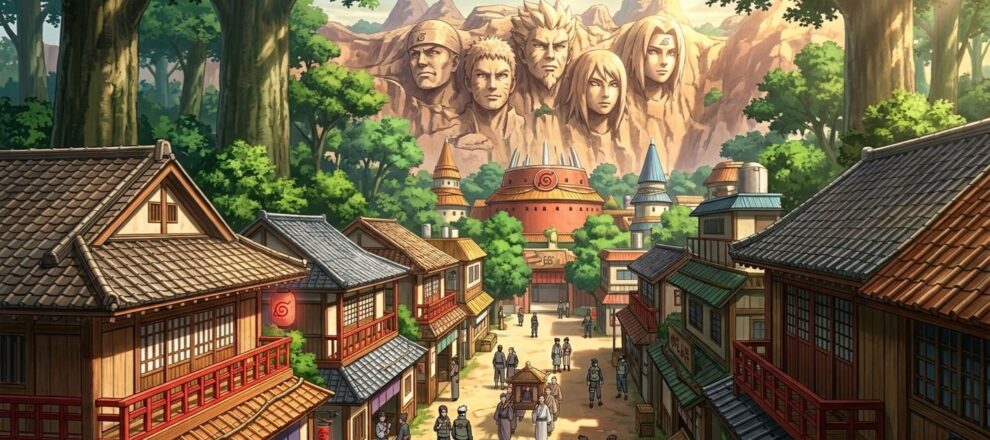
Konoha’s architecture blends traditional Japanese design with practical ninja requirements. The Hokage Rock—four faces carved into a mountainside—directly references Mount Rushmore while simultaneously evoking the Buddha statues of Nara and Kyoto. This dual inspiration suggests Konoha’s self-conception as both revolutionary (the American reference) and spiritually grounded (the Buddhist reference).
The village’s political structure draws from feudal Japan’s complex hierarchy. The Hokage position combines aspects of the shōgun (military leader) and the daimyō (feudal lord), while the village’s relationship with the Land of Fire’s feudal lord mirrors Tokugawa-era arrangements where military and civilian authorities maintained theoretically separate but practically intertwined power structures.
Konoha’s clan system reflects Japanese uji (clan) traditions, with family names indicating specialized functions and hereditary techniques. The Uchiha’s police force role, the Hyūga’s aristocratic bearing, and the Nara’s deer-raising medicine traditions all parallel how historical Japanese clans developed specialized economic and social functions. The gradual decline of clan distinctiveness throughout the series subtly mirrors Japan’s Meiji-era modernization, when clan structures were formally abolished to create national identity.
Sunagakure: Desert Culture and Middle Eastern Influences
The Hidden Sand Village presents the most geographically obvious cultural departure from Japan. Located in the Land of Wind’s desert environment, Sunagakure draws primarily from Middle Eastern and North African traditions while maintaining Japanese narrative integration.
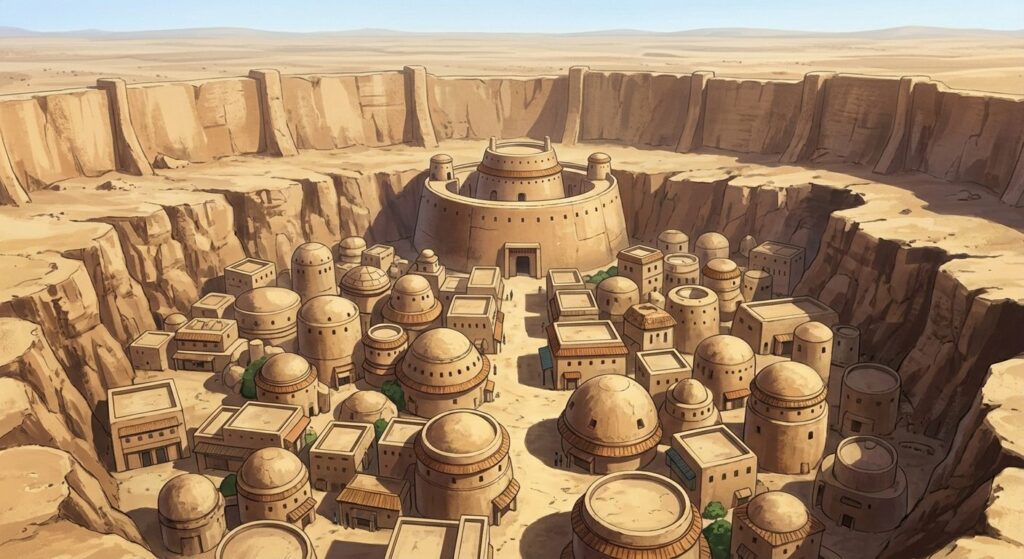
Sunagakure’s architecture—domed buildings, wind-resistant structures, underground networks—reflects historical desert city planning from Petra to Marrakech. The village’s water scarcity and economic dependence on limited resources mirror real-world challenges faced by desert civilizations, where control of water sources determined political power. The Kazekage’s palace, elevated above the common population, visually represents this resource hierarchy.
The village’s combat philosophy emphasizes efficiency and conservation—using minimal resources for maximum effect. The Puppet Technique, developed by Sasori and utilized by Kankurō, transforms this environmental necessity into artistic expression. Puppetry traditions exist across cultures, but Sunagakure’s mechanical, weaponized versions particularly evoke the sophisticated automata developed in Islamic Golden Age engineering and later European clockwork traditions.
Gaara’s character arc—initially presented as emotionally isolated, later becoming Kazekage through demonstrated protective capacity rather than lineage—subverts traditional monarchical expectations while maintaining the narrative’s meritocratic themes. His sand-based techniques, controlled through maternal protection rather than personal power, introduce emotional complexity to what might otherwise be simple elemental magic.
Kirigakure: Mist, Bloodshed, and Southeast Asian Influences
The Hidden Mist Village carries the darkest reputation among the five great nations, historically termed the “Village of the Bloody Mist” for its graduation requirement that students kill each other. This brutality, eventually revealed as manipulation by Obito posing as Madara, nonetheless reflects real-world military traditions where elite status required demonstrated willingness to kill.
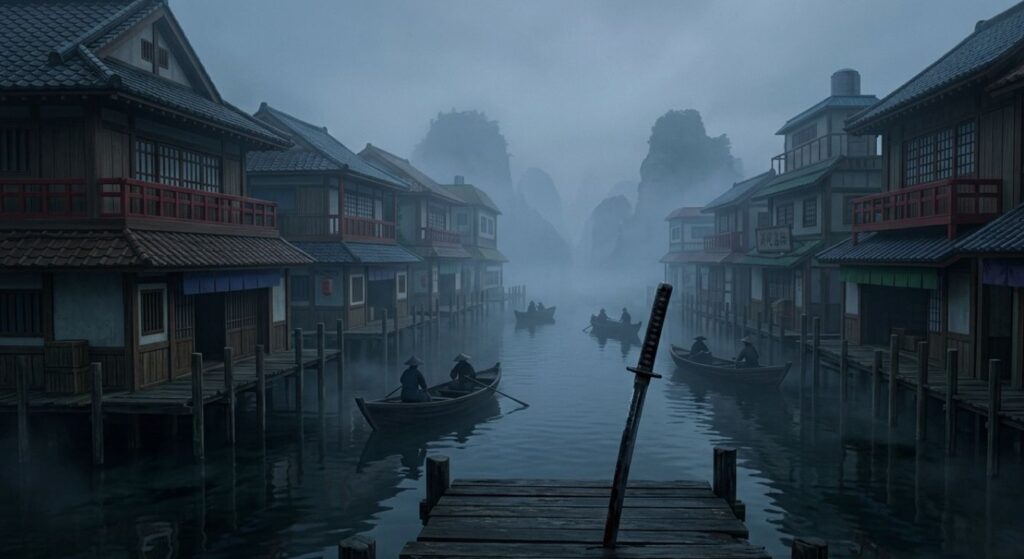
Kirigakure’s mist-shrouded environment draws from Southeast Asian geography—particularly the Mekong Delta’s seasonal fogs and the maritime mists of Indonesia and the Philippines. The village’s island location and naval focus parallel historical Southeast Asian maritime powers like the Srivijaya and Majapahit empires, which controlled trade routes through naval superiority.
The Seven Swordsmen of the Mist represent a distinct warrior tradition combining Japanese samurai aesthetics with Southeast Asian bladed weapon diversity. Each sword’s unique abilities—Samehada’s chakra consumption, Kubikiribōchō’s regeneration—transform practical weapons into mythological objects resembling the enchanted weapons found across Southeast Asian folklore.
Kirigakure’s political instability, experiencing multiple violent leadership transitions, reflects historical patterns in maritime Southeast Asia where distance from central authority enabled rapid regime changes. The village’s eventual stabilization under the Fifth Mizukage, Mei Terumī, parallels contemporary Southeast Asian democratic transitions—imperfect, contested, but directionally toward institutional legitimacy.
Iwagakure: Earth, Stability, and East Asian Continental Power
The Hidden Stone Village receives less narrative attention than its counterparts, but its cultural influences remain discernible. Located in the Land of Earth, Iwagakure emphasizes stability, endurance, and overwhelming force—values associated with continental East Asian powers, particularly China.
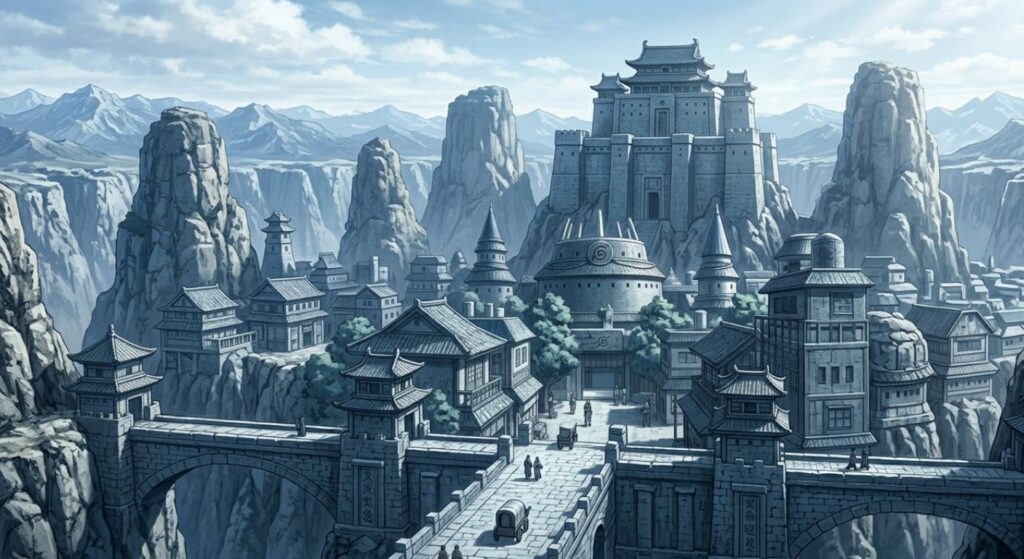
The village’s architecture—stone buildings carved into mountain faces, underground tunnel networks—reflects Chinese engineering traditions from the Longmen Grottoes to underground defensive structures. Iwagakure’s emphasis on ninjutsu that manipulates stone and earth parallels Chinese geomantic traditions (feng shui) that understand human fortune as connected to geographical features.
The Tsuchikage position, held by Ōnoki for decades, reflects Chinese and broader East Asian traditions of gerontocratic leadership—respect for elderly rulers whose experience supposedly compensates for physical decline. Ōnoki’s stubborn commitment to village interest over broader cooperation initially, and his eventual participation in Allied Shinobi Forces, mirrors historical patterns where Chinese dynasties prioritized internal stability until external threats demanded alliance.
Iwagakure’s techniques, particularly the Dust Release that combines fire, earth, and wind natures, suggest alchemical traditions where combining elements produces transcendent results. This “kekkei tōta” (bloodline expansion) beyond normal “kekkei genkai” (bloodline limit) represents hierarchical thinking about power and knowledge familiar from Confucian educational traditions.
Kumogakure: Lightning, Speed, and African Diaspora Influences
The Hidden Cloud Village presents the most explicitly non-Japanese cultural presentation, particularly through its darker-skinned inhabitants and distinct aesthetic traditions. While anime’s representation of race requires critical examination, Kumogakure’s design clearly draws from African and African diaspora influences combined with Japanese narrative integration.
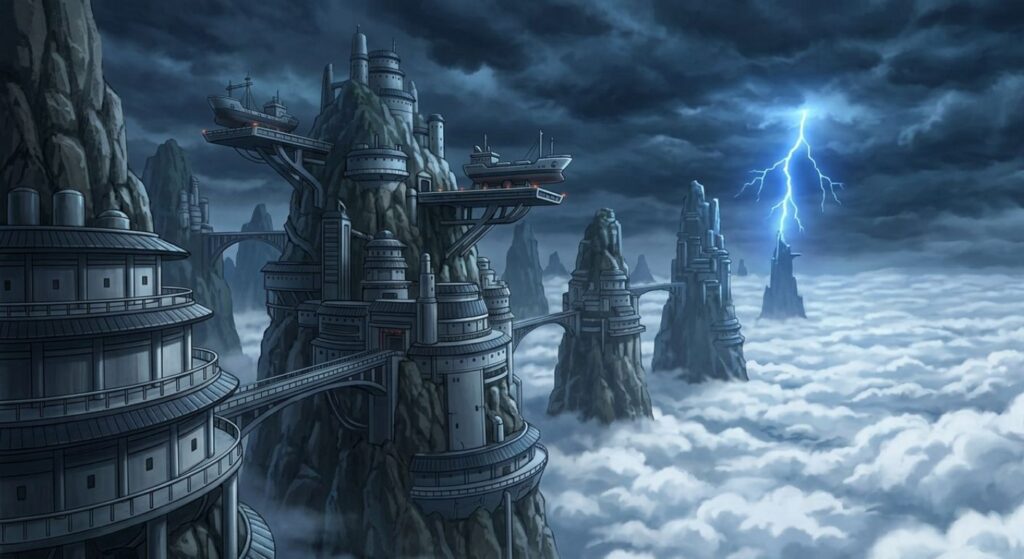
The village’s name and lightning association reference both meteorological reality—lightning’s association with storms—and religious traditions where lightning deities hold prominent positions across African and Afro-Caribbean spiritual systems. The Raikage position’s emphasis on physical power and speed parallels traditions of warrior kingship found across West African history.
Killer Bee’s character—rapping, wrestling, presenting exaggerated performative confidence while harboring genuine emotional depth—navigates complex representational territory. His jinchūriki status and eventual friendship with Naruto provide narrative redemption, though his initial presentation risks stereotype. The character nonetheless introduces cultural practices (rap, wrestling) previously absent from the ninja world, suggesting Kumogakure’s distinct cultural development.
The village’s relative isolationism until the Fourth Great Ninja War, and its aggressive response to perceived threats (attempted kidnapping of Hinata, conflict with Konoha), mirrors historical patterns where African and diaspora communities developed defensive cultures against external exploitation.
Minor Villages and Global Diversity
Beyond the five great nations, Naruto introduces numerous smaller villages—Takigakure (Waterfall), Amegakure (Rain), Otogakure (Sound)—each with distinct characteristics suggesting broader cultural mapping. Amegakure’s industrial aesthetic and revolutionary politics evoke early twentieth-century urbanization and ideological conflict. Otogakure’s hidden, experimental nature suggests rogue state or terrorist organization structures.
The Land of Iron, with its samurai rather than ninja warriors, explicitly references Japanese history’s warrior class, presenting an alternative path for combat-focused societies. Its neutrality during ninja conflicts parallels historical Swiss or Vatican neutrality—maintained through demonstrated defensive capacity rather than weakness.
Conclusion: Cultural Synthesis as Worldbuilding
Kishimoto’s cultural research serves narrative function beyond mere aesthetic variety. By grounding each village in recognizable cultural traditions, he creates immediate comprehensibility—viewers intuitively understand that Sunagakure faces resource constraints, that Kirigakure’s isolation produces suspicion, that Iwagakure’s stability enables conservatism. These cultural logics make the ninja world’s geopolitics feel coherent rather than arbitrary.
However, this cultural mapping requires critical engagement. The series sometimes reinforces stereotypes—Kirigakure’s violence, Kumogakure’s aggression—and flattens complex traditions into accessible anime aesthetics. The “exotic” presentation of non-Japanese villages, while common in fantasy worldbuilding, risks othering real-world cultures.
Nonetheless, Naruto‘s cultural synthesis ultimately serves themes of mutual understanding across difference. The Allied Shinobi Forces’ formation requires villages to recognize shared interests despite cultural distinctiveness—a message resonating with contemporary global challenges. By showing that Konoha’s “way of the ninja” isn’t universally superior, merely one valid approach among many, the series validates cultural pluralism while maintaining narrative focus on universal human experiences: connection, loss, growth, and hope.
The hidden villages remain hidden no longer—they reveal themselves as thoughtful engagements with human cultural diversity, transformed through imagination into settings where ancient wisdom and contemporary concerns meet.