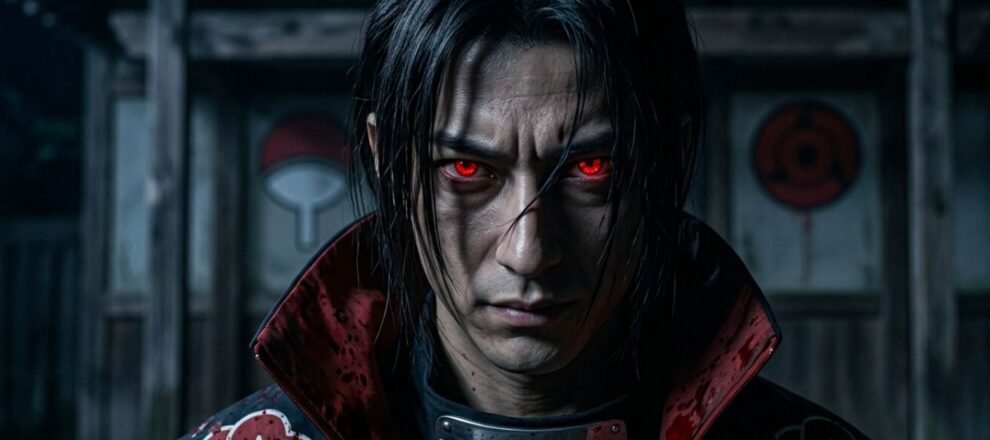
Few characters in anime history generate the sustained debate, emotional investment, and interpretive disagreement that Itachi Uchiha commands. Introduced as the genocidal traitor who murdered his entire clan, leaving only his younger brother alive as “spare parts” for his own power, Itachi initially embodied pure villainy. His eventual revelation as a double agent who committed atrocities to prevent greater catastrophe transformed audience understanding while complicating moral evaluation. Years after Naruto‘s conclusion, Itachi remains a Rorschach test for viewers’ ethical frameworks—a character whose actions simultaneously demonstrate profound sacrifice and unforgivable violence, heroic commitment and catastrophic manipulation.
The Architecture of Villainy: Introduction and Initial Function
Itachi’s first appearances establish him through pure menace. The massacre of the Uchiha clan—393 bodies including children, parents, elders—positions him beyond conventional antagonism into monstrosity. His confrontation with Sasuke in the Hidden Leaf Village, where he effortlessly defeats his brother while psychologically tormenting him through revived trauma, demonstrates cruelty that seems gratuitous rather than strategic.
This presentation serves crucial narrative functions. Itachi provides Sasuke’s motivation, creates the revenge narrative driving early Naruto, and establishes the Akatsuki’s threat level through association. As a literary device, he operates as shadow figure—the darkness Sasuke must overcome to achieve identity independence. His initial characterization draws from classical tragedy’s antagonists: intelligent, powerful, mysteriously motivated, seemingly beyond redemption.
The genius of Itachi’s construction lies in Kishimoto’s simultaneous planting of inconsistencies that reward rewatching. Itachi’s tears when killing his parents, his refusal to kill Sasuke despite claimed motives, his curious protection of Konoha information during capture attempts—these details initially appear as plot holes or character inconsistencies. Their later revelation as deliberate characterization creates one of anime’s most effective narrative reversals.
The Revelation: Heroism Through Atrocity
Itachi’s true motivations, revealed through Obito’s exposition and Itachi’s own posthumous encounters, reframe every previous appearance. He acted under Danzō Shimura’s orders, eliminating his clan to prevent their planned coup d’état that would have triggered civil war and foreign invasion. He accepted eternal condemnation—villain’s death, brother’s hatred, historical infamy—to preserve the village he loved and protect the brother he cherished.
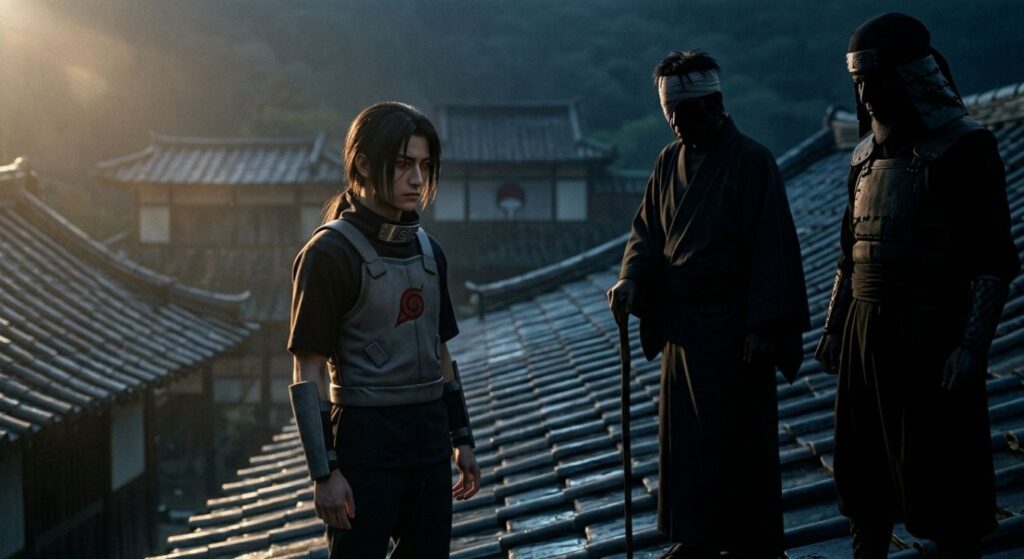
This revelation transforms literary classification. Itachi becomes tragic hero in the classical sense: someone of extraordinary capability destroyed by impossible circumstances. His hamartia (tragic flaw) isn’t personal weakness but situational impossibility—no available choice permits moral purity. Killing innocents to prevent greater killing; protecting Sasuke through psychological torture; serving as double agent within terrorist organization—these actions demonstrate not corruption but the corruption forced upon those who engage with fundamentally compromised systems.
The massacre specifically illustrates dirty hands moral philosophy, where political necessity requires actions that remain morally wrong despite their instrumental justification. Itachi doesn’t claim his actions were good; he claims they were necessary. This distinction separates him from conventional heroes who maintain moral cleanliness through plot convenience. Itachi inhabits the uncomfortable territory where good intentions produce damnable outcomes, where protecting the innocent requires becoming the monster others fear.
The Burden of Secrets: Psychological Cost of Double Consciousness
Itachi’s narrative power derives significantly from his sustained secret-keeping. For eight years, he maintains dual identity: Akatsuki member performing villainy, Konoha loyalist preventing catastrophe, loving brother presenting as torturer. This divided self produces psychological damage evident in his deteriorating health, his isolated existence, his desperate hope that Sasuke will kill him and achieve strength through vengeance.
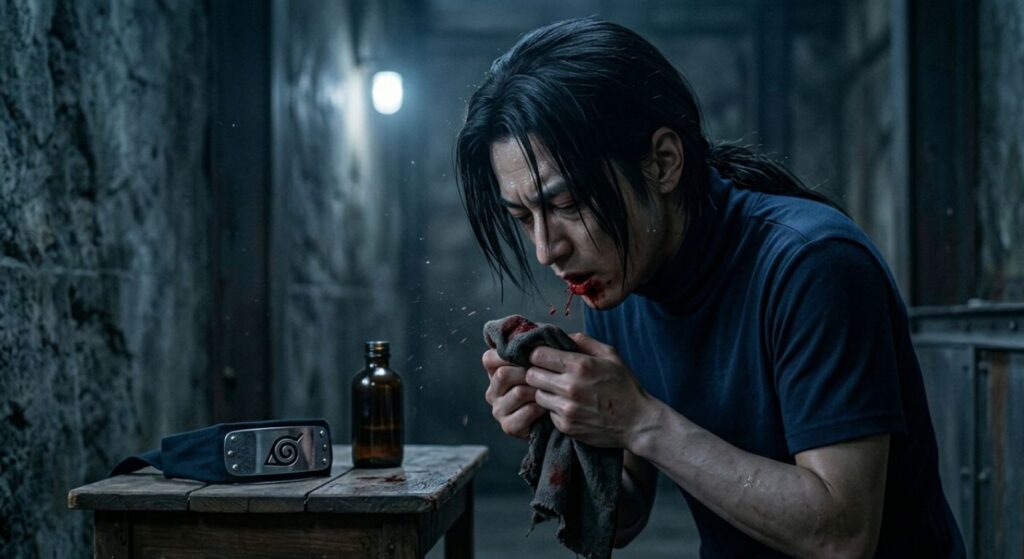
The secret’s weight manifests physically. Itachi’s illness—never fully specified but implied as stress-related autoimmune condition—embodies the psychological cost of his deception. He cannot seek medical treatment without revealing identity; cannot form genuine relationships without endangering others; cannot express grief for his parents or clan without compromising his performance. His famous line to Sasuke—”You don’t have enough hate”—reads as cruel manipulation until understood as desperate hope that his brother’s hatred will prove sufficient for the revenge Itachi requires as release.
Literary frameworks identify this as tragic irony where the audience knows more than characters, but Itachi’s case reverses conventional application. We initially shared Sasuke’s ignorance, experiencing Itachi’s cruelty as genuine. The revelation doesn’t produce dramatic irony’s typical pleasure but rather retrospective horror—recognizing that Itachi’s “villainy” was performance, his “cruelty” was calculated protection, his apparent strength was desperate illness and exhaustion.
Familial Sacrifice: Love Expressed Through Damage
Itachi’s relationship with Sasuke constitutes the narrative’s emotional core and its most contested element. His decision to spare Sasuke, then manipulate him toward vengeful strength, then program him with Kotoamatsukami to protect Konoha, demonstrates paternalistic love that denies the beloved’s autonomy. Itachi chooses Sasuke’s path repeatedly: life over death, hatred over grief, protection over freedom.
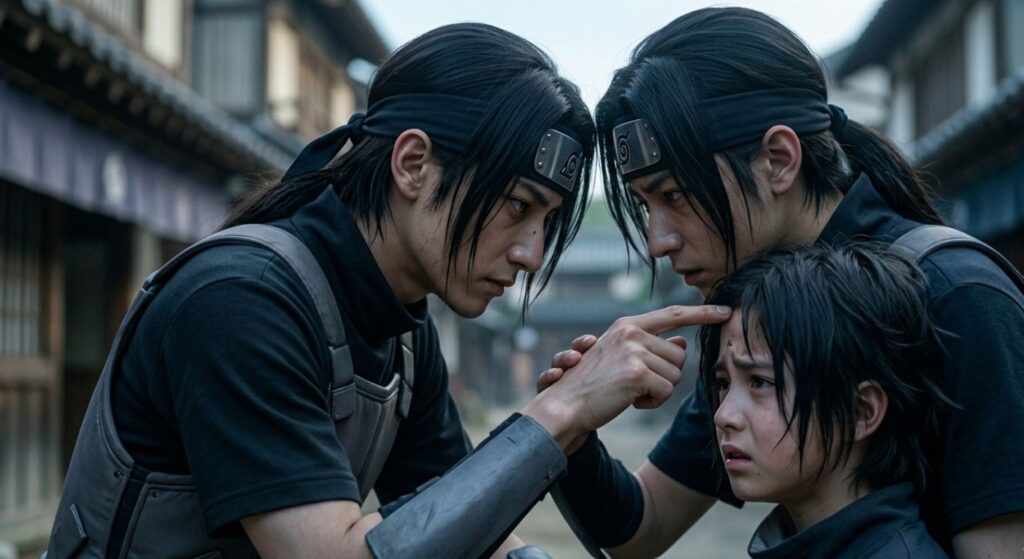
This dynamic generates legitimate criticism. Itachi’s manipulation arguably damaged Sasuke more profoundly than honest revelation would have. The psychological torture, the years of hatred, the eventual discovery that his life’s purpose was manufactured by the brother he sought to kill—this constitutes harm that Itachi’s good intentions don’t erase. The narrative’s eventual forgiveness, with Sasuke understanding and accepting Itachi’s choices, reflects Japanese cultural values of filial piety and collective harmony that may not translate universally.
Yet Itachi’s final words to Sasuke—”I will love you always”—spoken after the Edo Tensei’s release allows genuine emotion for the first time, suggest that his manipulation coexisted with authentic feeling rather than replacing it. He genuinely loved; he genuinely sacrificed; he also genuinely controlled and damaged. These truths don’t negate each other but coexist in the moral complexity that defines his character.
Anti-Hero Classification: Beyond Binary Morality
Literary taxonomy offers anti-hero as classification for protagonists lacking conventional heroic qualities, but Itachi’s case requires expansion. He isn’t anti-hero in the conventional sense—unlikable but ultimately justified protagonist—because his role spans antagonist and posthumous mentor without stable heroic positioning. Better classification emerges through tragic anti-hero: someone whose admirable qualities (loyalty, sacrifice, love) produce catastrophic outcomes through flawed application or impossible circumstances.
Itachi’s tragedy specifically involves knowledge without power. He comprehends the political situation’s full complexity—Uchiha grievances, Danzō’s manipulation, village vulnerability, international threat—but lacks capacity to resolve it without massacre. His genius becomes curse: sufficient understanding to recognize necessary evil, insufficient power to find alternative paths. This differs from conventional heroes who find third options through narrative convenience or moral purity that reality doesn’t permit.
His posthumous redemption through Edo Tensei—finally fighting alongside Sasuke, finally explaining himself, finally receiving acknowledgment—provides narrative closure without moral resolution. The story validates his love while not fully excusing his methods; acknowledges his sacrifice while recognizing its damage. This ambiguity, refusing comfortable categorization, sustains Itachi’s fascination.
Contemporary Resonance: Itachi and Modern Ethics
Itachi’s character achieves contemporary relevance through engagement with utilitarianism’s limits. His massacre represents classic utilitarian calculation: harm to many (Uchiha clan) prevents harm to more (village, nation, potential war casualties). Yet the narrative’s discomfort with this logic, its sustained attention to Itachi’s suffering and Sasuke’s damage, questions whether such calculations can ever be clean.
Modern audiences encounter similar logic in security policy, counterterrorism, and public health—situations where protecting collective welfare appears to require harming individuals. Itachi’s case doesn’t resolve these debates but embodies their emotional and psychological costs. He demonstrates that “necessary” evil doesn’t become less evil through necessity; that those who perform it don’t emerge unscathed; that the secrets required for such operations corrupt both keeper and community.
His eventual choice to trust Sasuke with truth rather than continued manipulation—revealed through his final actions and Edo Tensei release—suggests development even after death. Having learned that control failed, he finally offers love without strings. This trajectory from paternalistic manipulation to genuine respect mirrors developmental ideals for modern ethics: moving from “I know what’s best for you” to “I trust your capacity to choose.”
Conclusion: The Necessity of Itachi’s Ambiguity
Itachi Uzumaki resists final classification because his character embodies genuine moral complexity that simple labels diminish. He was villain to his victims, hero to those he protected, tragic figure to himself, damaging presence to his brother, loyal shinobi to his village, mass murderer to history. These identities don’t synthesize into coherent whole; they remain in productive tension.
The character’s endurance in anime discourse—continuing debate, continued artistic homage, sustained emotional engagement—demonstrates that audiences crave this complexity. Simple heroes and simple villains satisfy temporarily; characters whose good intentions produce harm, whose love manifests as damage, whose heroism requires villainy, reward sustained consideration.
Itachi’s final legacy may be the question he poses rather than any answer he provides: whether love can exist without control, whether protection can occur without paternalism, whether the systems requiring such choices can ever be justified. He remains, appropriately, the ghost haunting Naruto‘s conclusion—present in Sasuke’s eventual choices, in Konoha’s reconstructed identity, in the narrative’s refusal to let its heroes forget that saving the world sometimes requires becoming the monster.