Naruto did not merely participate in the shonen genre—it fundamentally reshaped it. While Dragon Ball Z established the power-scaling blueprint and One Piece perfected the serialized adventure formula, Masashi Kishimoto’s masterpiece elevated what a fight could mean. Kishimoto understood that the most memorable battles are not merely collisions of technique, but confrontations between ideologies, traumas, and hopes. Across seven hundred episodes, Naruto consistently delivered combat sequences that made viewers weep as violently as they cheered, introducing narrative frameworks, visual storytelling methods, and emotional architectures that subsequent shonen anime—from Attack on Titan to Jujutsu Kaisen—would adopt as standard practice.
The following ten fights did not just thrill audiences; they expanded the vocabulary of what shonen action could express.
10. Shikamaru vs. Hidan: Intelligence as Spectacle
Before this confrontation, shonen anime largely operated on a simple principle: whoever punched harder won. Shikamaru Nara’s battle against the immortal Akatsuki member Hidan demolished that assumption. What unfolds is not a contest of chakra reserves but a chess match played across an entire forest, with every trap laid hours in advance. Shikamaru avenges his mentor Asuma not through a sudden power-up, but through meticulous planning, emotional discipline, and the willingness to sacrifice his own safety to lure Hidan into a deathtrap.
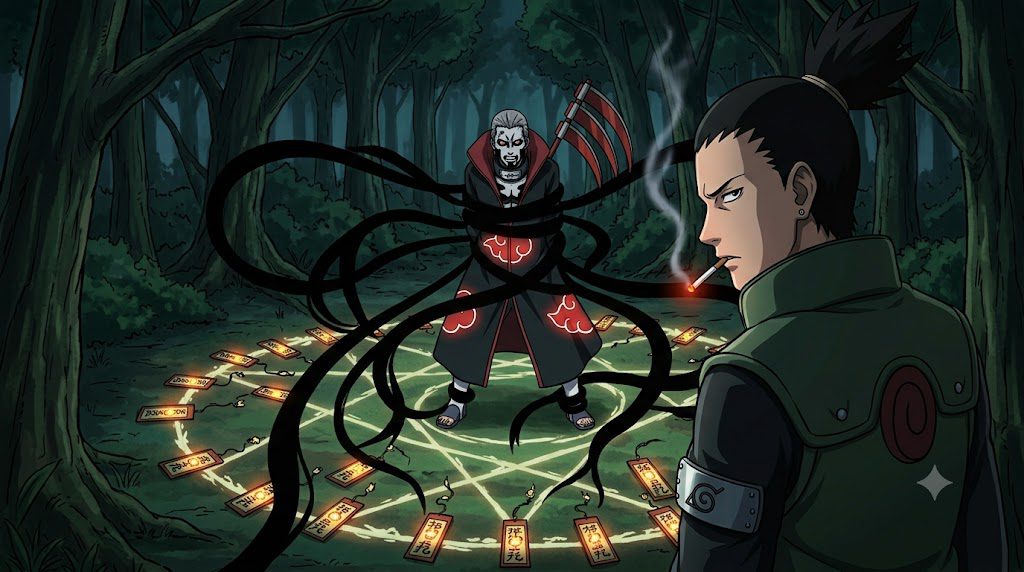
This fight redefined shonen combat by proving that strategy could generate the same adrenaline as spectacle. It validated the “support character” as a protagonist-worthy combatant and demonstrated that outsmarting an opponent could feel more satisfying than overpowering them. Modern series like Dr. Stone and Classroom of the Elite owe their celebration of intellect-over-brawn partly to Shikamaru’s triumph.
9. Hiruzen vs. Orochimaru: The Weight of Legacy
The battle between the Third Hokage and his rogue student marked the first time Naruto showed audiences what Kage-level combat truly looked like—and what it cost. Set against the backdrop of the Chunin Exams invasion, this fight carried unprecedented emotional density. Orochimaru’s use of the Impure World Reincarnation to revive Hiruzen’s own teachers forced the old Hokage to confront his failures as both a leader and a mentor.
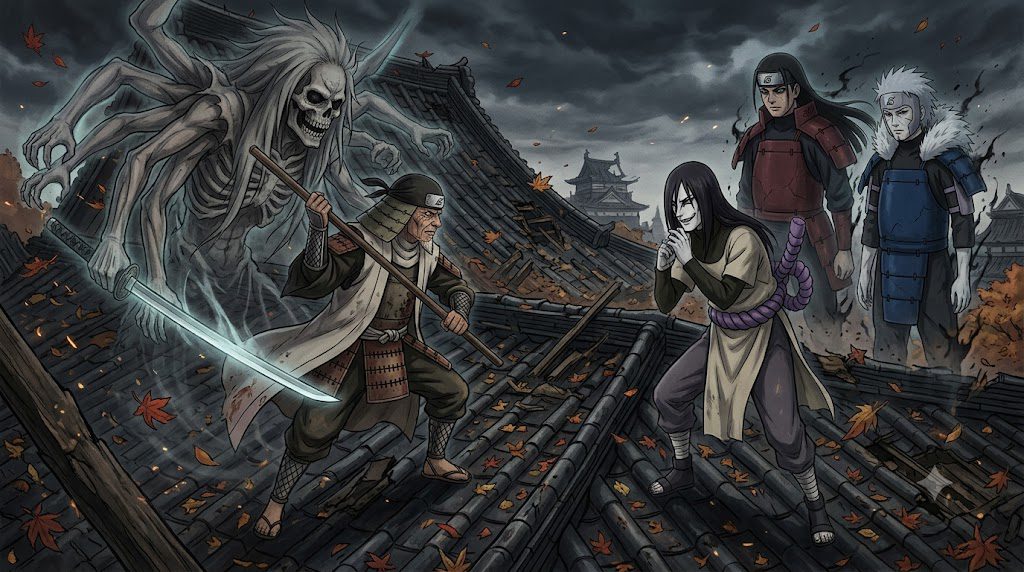
The introduction of the Death Reaper Seal, a forbidden technique requiring Hiruzen’s own life, established a crucial shonen precedent: victory could demand absolute sacrifice. This was not a tournament bout with a trophy at stake; it was a tragedy in real time. The fight taught the genre that combat between teacher and student could carry the gravity of Greek drama, a lesson later absorbed by everything from My Hero Academia to Demon Slayer.
8. Jiraiya vs. Pain: The Asymmetry of Knowledge
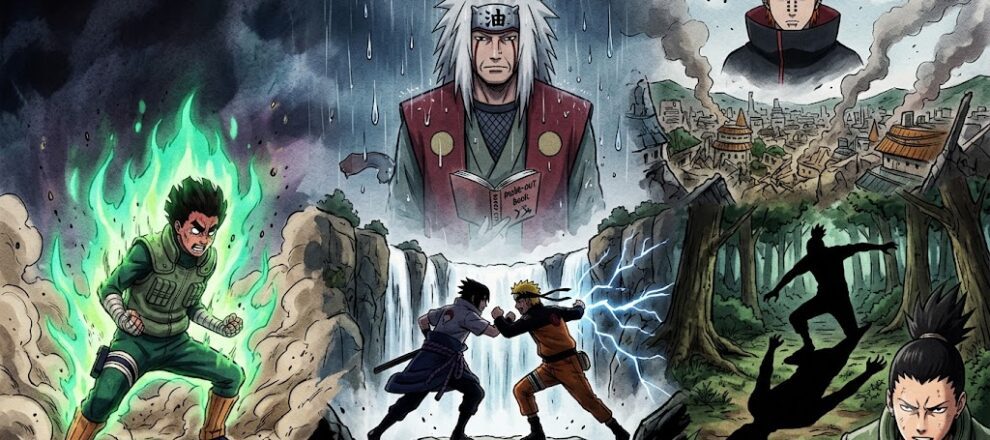
Jiraiya’s final stand in the Hidden Rain Village redefined how shonen anime could handle the death of a beloved mentor. Unlike the sudden, shocking losses common in other series, Jiraiya’s defeat is agonizingly deliberate. He dies not because he lacks power, but because he chooses to gather intelligence rather than escape. The fight operates on a terrifying information gap: Pain knows everything about Jiraiya’s techniques, while Jiraiya must decipher six entirely different bodies in real time.
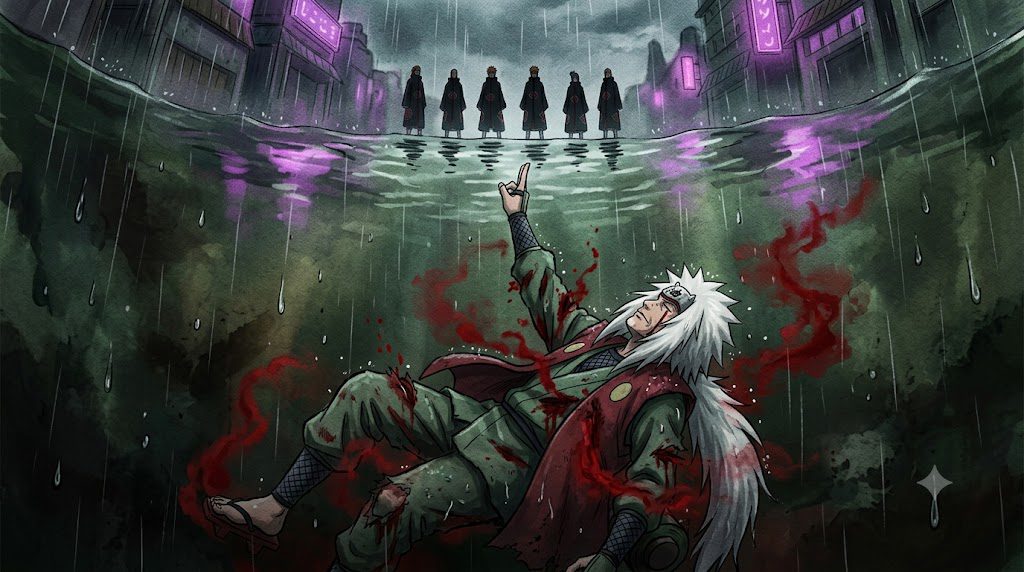
The emotional devastation comes not from the violence but from the recognition. When Jiraiya realizes his former student Nagato has become Pain, the fight transforms from a mission into a funeral. This established a new template for mentor deaths in shonen—meaningful, information-rich, and thematically devastating rather than merely shocking. The image of Jiraiya sinking beneath the water, still trying to decode the secret, remains one of anime’s most haunting expressions of duty.
7. Team 7 vs. Zabuza & Haku: Antagonists as Humans
The Land of Waves arc served as Naruto’s declaration that it would not treat antagonists as disposable obstacles. Zabuza Momochi and Haku were the first enemies who possessed interior lives, dreams, and a bond that transcended their villainous roles. When Naruto witnesses Haku’s sacrifice and Zabuza’s subsequent breakdown—collapsing beside Haku’s body, unable to wield his sword through tears—the series proved that shonen battles could achieve genuine tragedy.
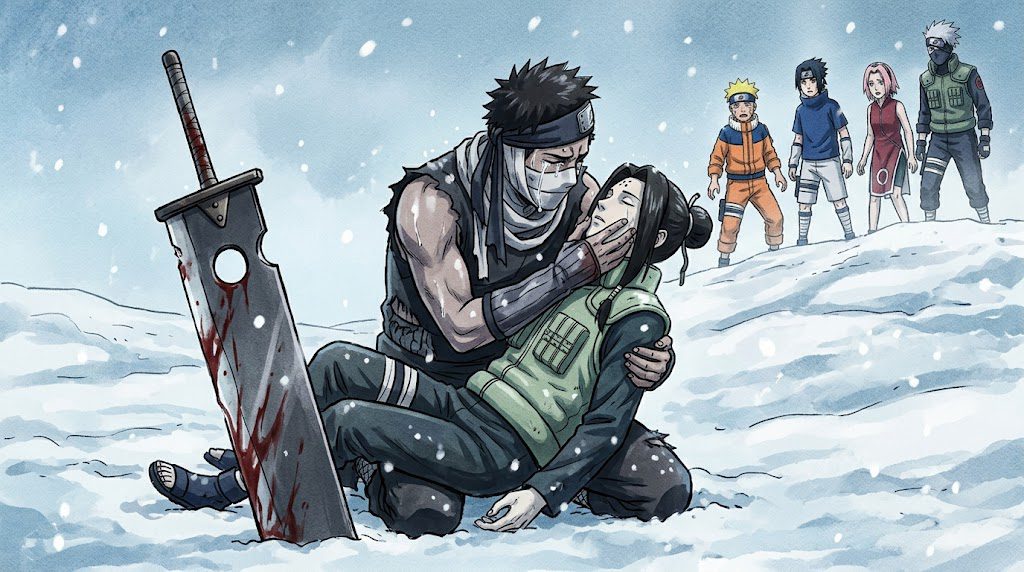
This arc introduced the concept that understanding an enemy’s humanity could be more transformative than defeating them. Naruto’s rage upon seeing Sasuke seemingly killed by Haku unlocked the Nine-Tails’ chakra for the first time, but the emotional climax belonged to Zabuza. By granting its first major villains a redemption through grief, Naruto taught the genre that even antagonists deserve emotional resolution.
6. Killer B vs. Sasuke: The Necessity of Humbling
By the time Sasuke Uchiha confronted Killer B, the series had spent hundreds of episodes establishing him as an unstoppable prodigy. The fight against the Eight-Tails Jinchuriki systematically dismantled that narrative. Killer B effortlessly outclasses Sasuke in swordsmanship, outmaneuvers his Sharingan, and fatally stabs him multiple times—saved only by the intervention of his teammates.
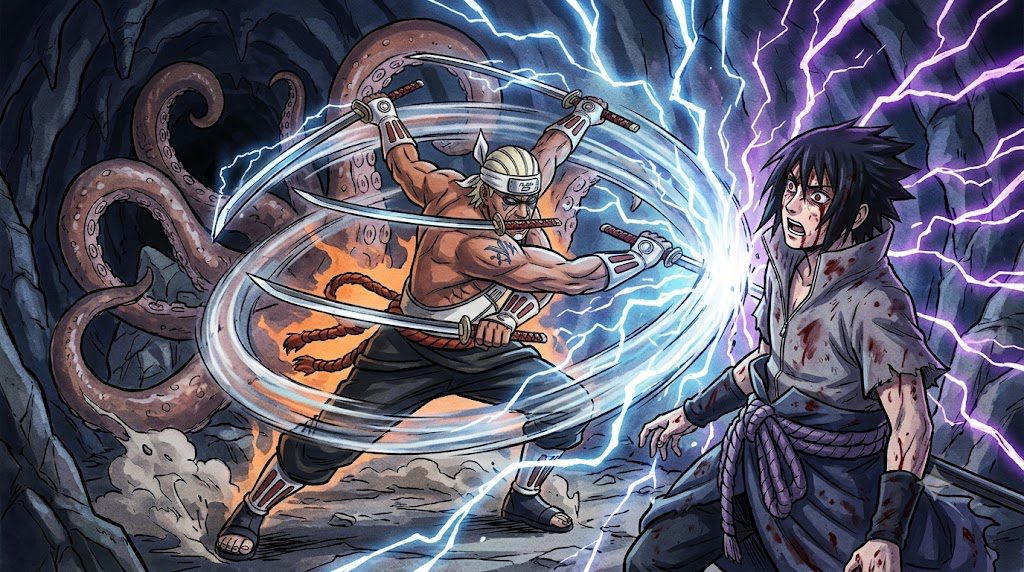
This battle reintroduced consequence into a genre increasingly addicted to power creep. It proved that no matter how special a protagonist or deuteragonist becomes, the world contains fighters who have trained longer, fought harder, and simply operate on another level. The humbling of Sasuke Uchiha reminded shonen anime that invincibility is boring, and that true growth requires the ego to be shattered before it can be rebuilt.
5. Kakashi vs. Obito: Memory as Choreography
When Kakashi Hatake and Obito Uchiha finally clashed inside the Kamui dimension, the fight transcended physical combat and became a dialogue across decades. What makes this battle genre-redefining is its seamless integration of flashback and present action. Childhood sparring sequences literally intercut with lethal adult combat, with the animation matching movements across time so precisely that past and present become indistinguishable.
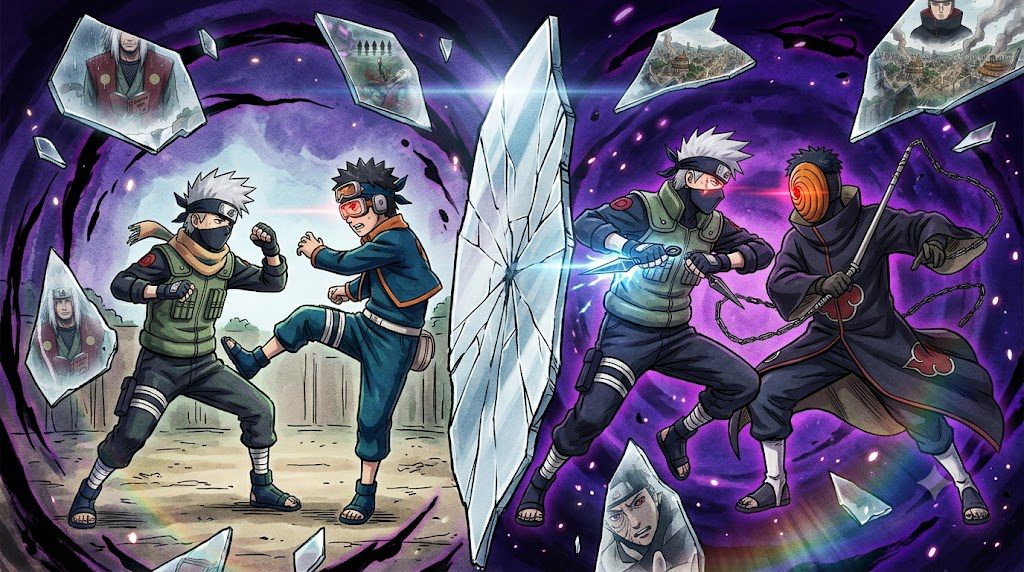
The emotional climax occurs when both men simultaneously reach for the same ninja tool from their childhood—and then deliberately choose to abandon that shared memory in favor of killing each other. This technique of using nostalgia as a weapon, of making the audience mourn a friendship while watching its violent dissolution, influenced how modern anime like Demon Slayer and Jujutsu Kaisen integrate memory into battle sequences. It proved that the most painful hits are not physical.
4. Itachi vs. Sasuke: The Anti-Climax as Climax
For nearly a decade of real-world storytelling, Sasuke’s entire existence revolved around killing his brother Itachi. When the confrontation finally arrived, Naruto subverted every expectation of what a revenge battle should be. Itachi did not die defeated; he died exhausted, having protected Sasuke one final time by sealing away Orochimaru and then simply… stopping. The forehead poke. The apology. The collapse.
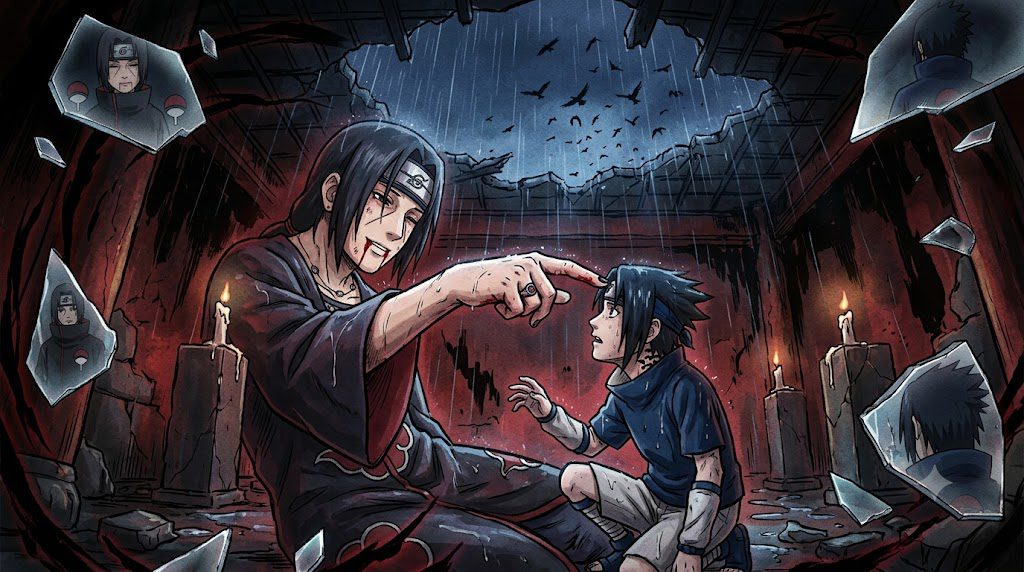
This fight redefined shonen by proving that the most devastating reveals could occur after the combat ended. It taught the genre that a battle’s resolution could be quiet, ambiguous, and emotionally annihilating rather than explosive. The revelation that Itachi was never truly the villain—that Sasuke’s entire motivation had been built on a lie—transformed the Uchiha tragedy from a simple revenge narrative into something far more complex. Subsequent series from Attack on Titan to Vinland Saga would adopt this model of the morally complicated, retrospectively devastating confrontation.
3. Rock Lee vs. Gaara: Hard Work Visualized
If one fight from Naruto deserves credit for defining an entire generation’s understanding of dedication, it is Rock Lee versus Gaara during the Chunin Exams. The setup is brutally simple: a genius protected by automatic defense versus a “failure” who can only use taijutsu. When Lee drops his leg weights—sending cracks through the arena floor—and moves too fast for the eye to track, the animation quality spikes to levels rarely seen in television anime at the time.
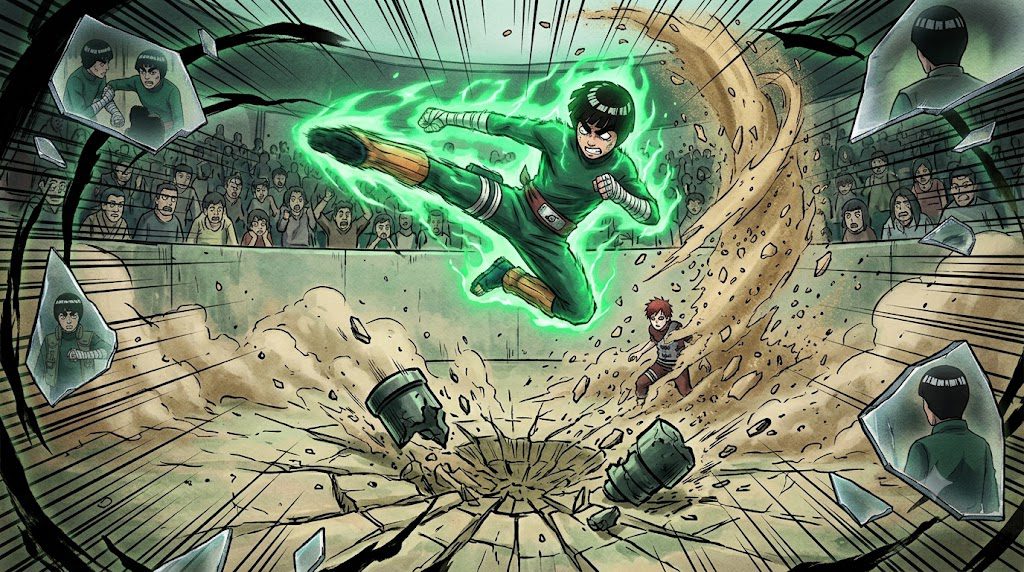
But what truly redefined shonen was the aftermath. Lee does not win. Opening the Eight Inner Gates allows him to shatter Gaara’s defenses, but the toll on his body destroys his ninja career in the process. The fight taught an entire generation that effort could be glorious even in defeat, that a side character could carry an episode’s emotional weight as powerfully as any protagonist, and that shonen anime could celebrate losing with the same intensity reserved for victory. The image of Lee, unconscious but still standing, remains the series’ most enduring tribute to perseverance.
2. Naruto vs. Pain: Empathy as a Weapon
The destruction of the Hidden Leaf Village and Naruto’s subsequent arrival in Sage Mode represent perhaps the single greatest entrance in anime history. But what elevates this fight beyond spectacle is its philosophical core. Pain is not a villain who wants destruction for its own sake; he is a traumatized orphan who genuinely believes that suffering creates peace. Naruto cannot defeat this ideology with a Rasenshuriken.
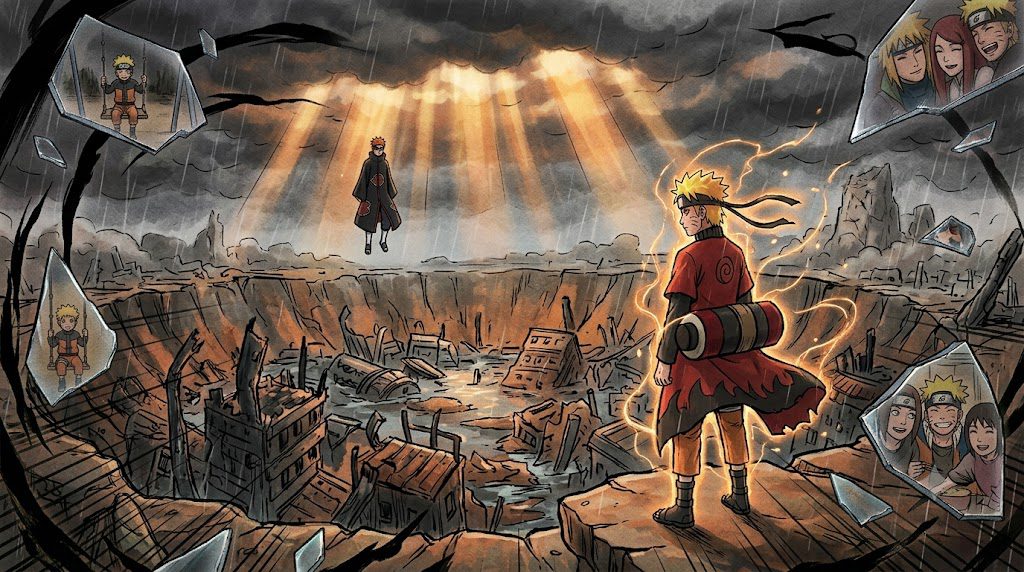
The fight redefined shonen protagonists by forcing Naruto to do something unprecedented: genuinely understand his enemy. When Hinata’s apparent death triggers the Nine-Tails rampage, the series teases the traditional shonen resolution—unleash enough rage to win. Instead, Naruto regains control, meets Nagato face to face, and chooses forgiveness over vengeance. This established that a shonen hero’s greatest strength could be emotional intelligence rather than destructive power, a radical notion that continues to influence protagonists like Tanjiro Kamado and Yuji Itadori.
1. Naruto vs. Sasuke (Final Battle): The Rivalry Perfected
Four hundred episodes of buildup culminated in a confrontation that stripped away god-tier techniques and returned to fistfighting at the Valley of the End. After wielding the powers of tailed beasts and Rinnegan, Naruto and Sasuke exhaust their chakra and simply beat each other bloody in the rain, their faces swollen beyond recognition, their ideals reduced to raw desperation.
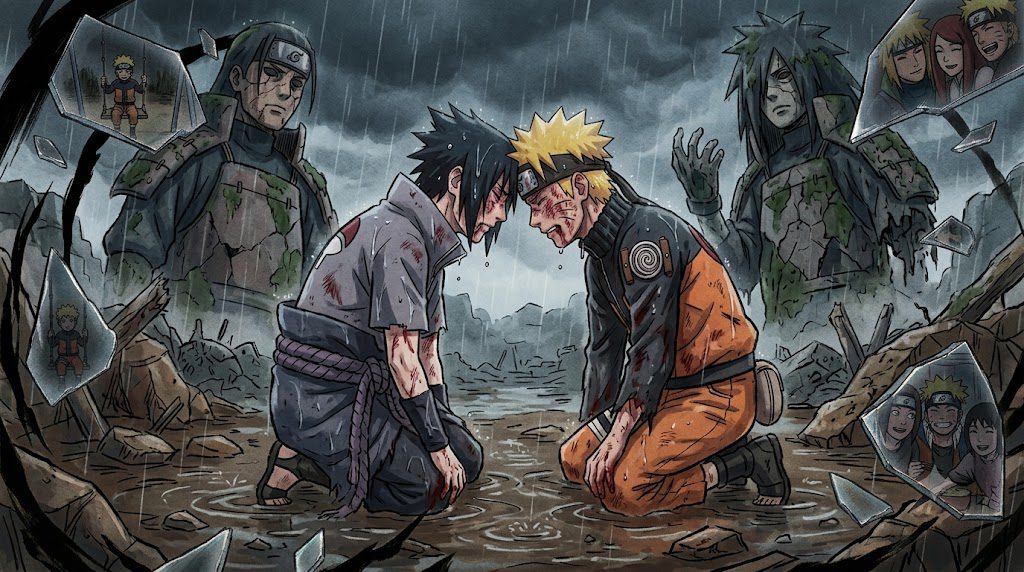
This fight perfected the shonen rivalry by proving that the most powerful techniques matter less than the emotional history between combatants. The animation—fluid, brutal, and intimate—abandoned flashy jutsu in favor of martial arts that felt physically exhausting to watch. When both boys lose an arm and collapse, unable to continue, the resolution arrives not through victory but through mutual survival. It redefined the genre’s approach to final battles by demonstrating that the only way to resolve a bond that deep was not to defeat the other person, but to refuse to let them fall alone.
Conclusion
These ten fights did more than entertain millions—they evolved the structural DNA of shonen anime. They proved that battles could serve as philosophical debates, that side characters could carry episodes with the weight of protagonists, that flashbacks could enhance rather than interrupt, and that losing could carry more meaning than winning. They demonstrated that antagonists deserved humanity, that mentors could die with purpose rather than shock value, and that a hero’s greatest weapon could be empathy rather than a new transformation.